Showing posts with label clothes. Show all posts

Tuesday, January 5, 2021

How I Make A Camica (Shift)


The shift (camica in Italian) is the basic undergarment for women of all classes and all styles of dress across western Europe from the early middle ages through the eighteenth century. While it goes by different names at different times and in different places, and the style does vary a bit, especially in later centuries, this is a good basic square necked shift pattern that will work for just about any Italian Renaissance outfit. While upper class camice were frequently embellished, and you can certainly do so to yours, a simple one will never look out of place with any Italian ensemble. While the Italian style isn't exactly the same as what is seen in Northern Europe in the 16th century, you could certainly get away with using this with English or German garb in a pinch. Just keep in mind that the Italian style of shift is much more voluminous, so if you need this to work with clothes from other regions, consider reducing the volume of fabric used, particularly in the body.

The pattern is extremely simple; it's just rectangles.  The linen I use is 58 inches wide, which is a lot wider than 16th century fabrics.  Since that's close to double a period loom width, I use one full fabric width total for the front and back (so a half width for the front and the other half width for the back).  Since I'm very petite, I could probably get away with a bit less if I was really trying to conserve fabric, but just using the full width makes cutting very simple, so that's what I do.  So the front and back pieces are one full fabric width by the desired length, which for me is just a little below the knee, though a lot of people prefer theirs longer.  The side panels are the same length by one quarter fabric width, and the sleeves are a quarter width by 6-12 inches longer than your arm, depending on how voluminous you want them to be.  One quarter width makes for a narrower sleeve; if you want yours more voluminous, use more fabric!  The underarm gussets are approximately 10x10 inch squares, which I cut out of the fabric left over from the difference between the sleeve and side panel lengths.  Cuffs and neck band are optional, depending on your style.

I like to use sheer linen,
but there are plenty of 
other fabric choices 
that work just as well.
I use about 2.5 yards of 58 inch wide fabric to make a camica, but if you're tall or want a really long one, you will probably need more.  I prefer a very light weight linen, because it can have a lot of volume without adding a lot of bulk.  Linen is the most correct period material, though cotton and linen/cotton blends were available in Italy and Spain in the 15th and 16th centuries.  Some reenactors use sheer silks, but there's little evidence for this in period.  The whole point of the camcia is to protect the not-very-washable silk and wool outer clothes from sweat and body oils, so it only makes sense to use an easily washable fabric.  While both cotton and linen are easy to wash, I prefer linen because I think it breathes better, and it also wicks moisture away from the body, rather than absorbing it like cotton, making it the most comfortable in hot weather.  The example garment in the pictures is a fine, sheer weight linen, though handkerchief linen is great, too.

I find flat felled seams
to be the most comfortable
finishing method for 
undergarments.

Start by sewing the sleeves together and inserting the gussets.  To do this, first line up one edge of a gusset with the top end of what will be the sleeve seam.  Sew them together right sides together.  Then sew the sleeve into a tube, stitching the adjacent side of the gusset to the other sleeve edge.  Once that's done, just stitch all the body pieces together.  I like to flat fell the seams on my camice, but French seams are also correct for the period.  Once that's done, finish the bottom edge with a narrow rolled hem (which is really easy to do on fine linen!).  Finish the sleeves either my hemming or by gathering them to narrow cuffs, and then gather (or smock, or whatever you want) your neckline to the desired width, which should at least peek out the top edge of your dress bodice.  I prefer to add a narrow neck band because it's easy and lies flat under my partlet, but it's really up to you.  Smocked and ruffled examples can be found in portraiture from the period.  Finally, if you have cuffed sleeves, add your fastenings.  I used hooks and eyes, but buttons and ties are also period.  

Adding the cuffs
And that's all there is to it; this is a really easy garment to make!  Like I said, this is a really simple garment, though the upper classes often wore embellished camice.  Blackwork, redwork, or polychrome embroidery all appear in art from the mid 16th century in Italy, as does lace insertion.  Decorative smocking is a pretty common and very attractive style of neckline finish for many different classes.  It's really up to you how much or how little embellishment you want on your garment.  Keep in mind, however, that while a simple camica looks good with a very fine court gown, a highly decorated one doesn't really work as well with working class garments.  One of the most important keys to putting together great historical costumes is remembering who you intend to portray and making sure all the pieces of the outfit fit that persona!

Tuesday, December 1, 2020

December Update

Partlet for a 1560s/70s Venetian outfit


 It's been a busy couple of months, and I haven't posted anything new, but that doesn't mean I haven't been sewing! I was working like a maniac for Halloween, making a full 1560's or '70's Venetian lady's ensemble for a friend, which was wearable for the day but still needs some work.  I also made a padded arming cap to prevent Younger Brother's helmet falling into his eyes.  I'm currently working on a lady's jerkin in gold silk (post coming soon!), but buttonholes are boring, and working on just one project for a long time sometimes gets monotonous, so I've also taken breaks from the big project to do little ones.  I made a cute embroidered apron to go with my working class dresses (a new one of those coming soon, too!), and am making myself a new camica because one isn't really enough if you plan to be in garb for a few days in a row.  

Apron embroidery


I've also done a lot of planning work for upcoming projects.  Working out the pattern for the jerkin gave me the bodice pattern I need for a fitted gown I'll be making this winter.  I'm in the middle of researching arming doublets of the mid to late 14th century as part of my brother's 14th century knight's gear.  I've mostly designed a 16th century Italian working class outfit I'd like to make for hot days at Faire in 2021.  I've figured out what pieces I'll need to make for the 15th century Florentine ensemble my mother wants, which meant hours of looking at 15th century art and showing her recreations of gowns.  I took advantage of Black Friday to get a lot of supplies for upcoming projects, including a German Trossfrau dress I've been wanting to make since I first saw pictures of them.  


Gold silk jerkin


I've also been working on getting an Etsy shop going for historical clothing.  Deciding how to stock it has been a challenge, though.  Some stock items, and other things made to order, perhaps?  I hope to have my shop going in the new year, so I'd better hurry up and figure it out!

So all in all, it's been a productive two months or so since I last posted, but it's also been the kind of productive that doesn't really mean a lot of pictures here.  Don't worry, it's all coming soon!


Blue velvet gown, not quite finished

Monday, July 20, 2020

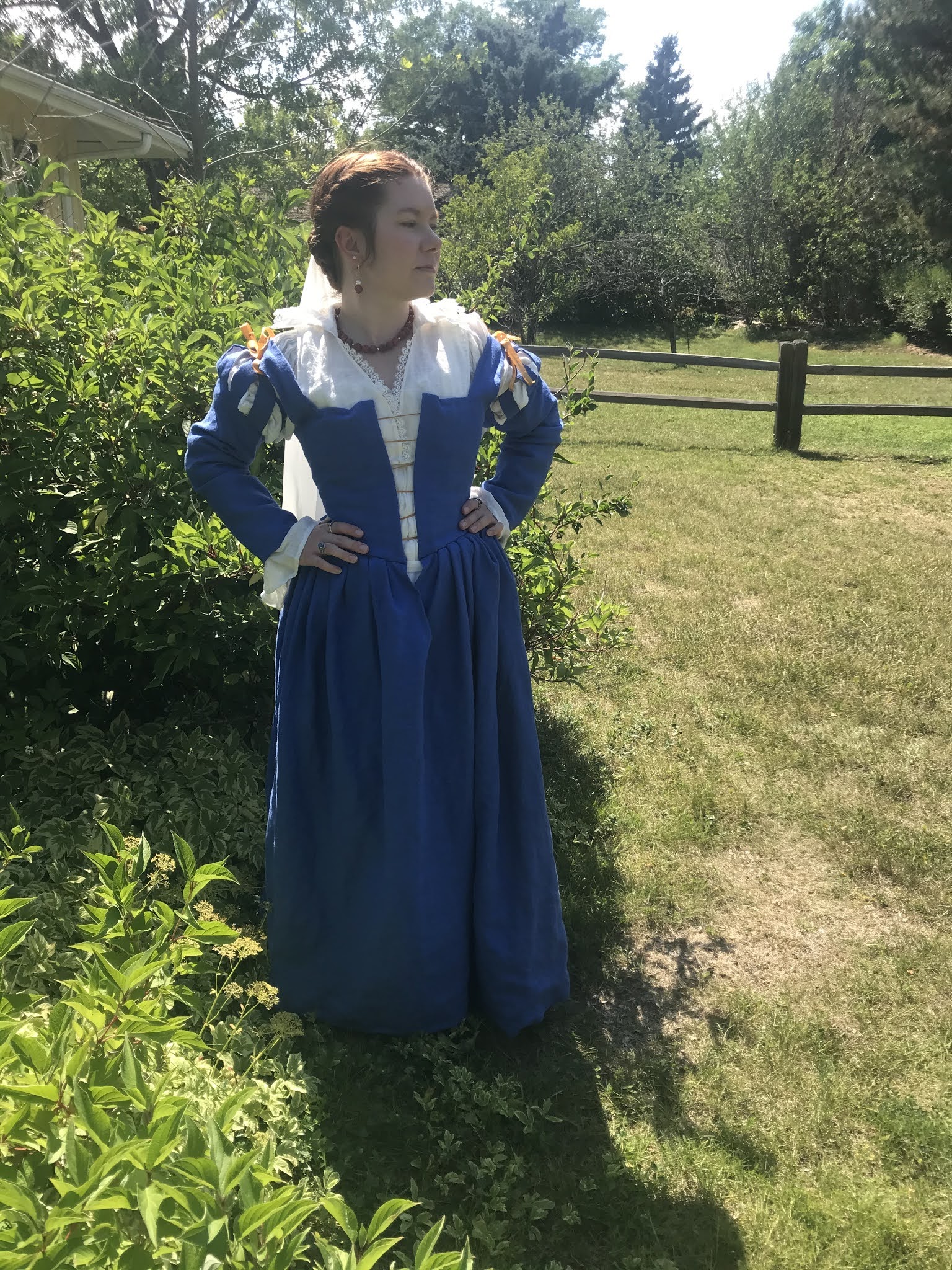
Progress on my Venetian Ensemble!


Failing a bit at "serious Renaissance portrait face," but you can
see the new accessories pretty well in this shot.  Don't mind the
modern second ear piercings I forgot to take out for pictures!

My local Renaissance Festival may have announced the cancellation of their 2020 season last week, but that doesn't mean I'm not still working on garb!  In between medieval pieces for a friend, I've done some work on my Venetian ensemble as well.  I made some coral earrings to go with my coral necklace last month, and hemmed some silk organza to make a veil.  I also bought some veil pins and another ring that works for the 16th century online.  It's not much, but I think it really helps pull my outfit together!


All the new things, plus the 2 rings I already had that can
pass for Italian Renaissance.  I'm really pleased with my
new earrings!


There's still some work to be done on this outfit.  I still think the skirt could use a little more volume to look like what you see in 1550's and 60's art, and I'm currently working on a corded petticoat that will (hopefully!) help with that.  I also plan to make a fancy underskirt, though I haven't even found fabric for that yet.  
Better serious Renaissance face here!
Unfortunately, Colorado looks
nothing like Venice.

I also need to add hooks and eyes to the slit in the skirt to hold it closed.  I thought it looked fine before, but I've been looking at more portraits, and the skirt is almost always closed just under the edge of the bodice.  I safety pinned it for these pictures, which makes it hang a little strangely.

I really need to fix my sleeves, too.  They're a little too tight at the top edge, which makes getting dressed difficult and also causes my sleeves to work their way down my arms, pulling the straps of the bodice with them.  Venetians were fond of the edge-of-the-shoulder look, but these are pulling too far and making it a little difficult to use my arms.  Plus it's creating a weird situation with my camica and partlet that needs constant adjusting.
The weird sleeve-strap-partlet-camica situation
is easier to see here.  I think I didn't leave enough
ease when making the sleeves, and then went back
to work after the quarantine and my arms got a little
more muscular, so the problem with fit became
much more obvious.

I plan to fix this by removing the stitches holding the panes together and adding a slightly bigger strip of fabric around the top edge of the sleeve in their place, adding maybe an inch to the sleeve circumference.  Will update with results.  I also plan to make a second pair of sleeves out of a remnant of silk brocade, which I'll do in the new way if that works better.  I also think that part of the problem is with my camica being a little too wide in the neck, though I haven't decided yet if I'm going to re-work it or just make a second one.  That depends on the results with the sleeves.  All in all, though, things are coming together nicely.  Now I just need somewhere to wear this...  Perhaps the grocery store?  Or my day job?


Another veil pic.  Because I think my veil is awesome.
So flowy and cute!  I need to get better at pinning it,
though.  


Wednesday, June 24, 2020

16th century Bodies (aka Corset)

Finished front
Pardon my phone (and my messy workspace!)
Finished back


There's a lot of debate among costumers as to whether or not corsets- commonly called "bodies" or "pairs of bodies" in period sources- were used much in 16th century Italy.  There's loads of evidence for them in England by the Elizabethan period, quite a bit in Spain, and even an extant pair from Germany, but the Italians seem to have prefered stiffened dress bodices rather than separate support garments.  This makes sense to me, since Italians were living in a much warmer climate than the English or the Germans, and so presumably would have been more comfortable with fewer layers.  That said, by the end of the century, dresses in portraits look stiff enough to me that I suspect either the bodices were made like corsets or the Spanish pair of bodies had come in to style.  There is an extant pair from Florence dated to 1562, but it's unclear whether this is a "pair of bodies", or corset, or a "petticoat bodies", which functions to hold up an attached underskirt as well as provide a little bust support.  Either way, though, this garment belonged to Elenora of Toledo, the Grand Duchess of Tuscany, who was of Spanish origin, so it's hard to be sure how much this says about what Italians were wearing.  Personally, I'm of the opinion that in Venice at least- which is where my focus is- corsets weren't in common use until very late in the century.

So why am I making one, you ask?  I do want to make at least one Elizabethan ensemble, so I need a pair of bodies for that- I have an could use a petticoat bodies, but that's a lot more bulk than I want to wear, especially at outdoor summertime events.  I'm also planning a doublet and hose for myself, and I don't really want to go to the trouble of trying to make a doublet bodice supportive enough.  I refuse to wear a modern bra under 16th century clothes, so a pair of bodies is required.  Finally, I intend to eventually make a Florentine dress in a style similar to the one Elenora wore over her bodies, and I'll need it for that outfit!

Since examples are few and far between for these things and the time and place I focus on probably didn't use bodies anyway, I wasn't especially concerned with historical perfectionism on this piece.  Tudor Tailor has patterns for two English styles of corset, but they're both fully boned and I don't really want to spend that kind of time sewing boning channels.  Boring!  Instead, I chose to base my bodies on the style of that German example I mentioned earlier, worn by Pfalzgrafin Dorothea Sabina von Neuberg, dated to 1598.  It's featured in both Tudor Tailor and Patterns of Fashion, so I have both step by step instructions and detailed diagrams to work from.  It's also much more lightly boned- only to the underbust and at the center back, so that's a lot less work for me.  There's only one problem: the center front is designed for a separate busk, and the bodies lace up the back.  As someone who wants to get dressed on her own, this is an issue, so I adjusted the pattern for front lacing by omitting the busk.

I also decided there was no point in starting from scratch when I already have a perfectly good bodice pattern that's shaped pretty much the same way, so rather than trying to scale the pattern up from a book, I just used the bodice pattern for my Venetian gown, omitting the Venetian back point to allow for waist tabs.  This is the same pattern I used for my blue linen Venetian dress, but with an elongated front point.  The front gap on this bodice makes it ideal for a corset, since it allows for any give in the fabric.  Since I've made a dress from this pattern already, I know it fits and therefore didn't bother with a mock up.  I cut out two front pieces and one back in fashion fabric, lining, and canvas.

One of the front pieces
marked out for the bones.
Pins hold the layers
together while I work.
Remember how I said I had step-by-step instructions I could follow?  Well, I chose to mostly ignore them and make this piece the same way I usually make dress bodices.  The first step was to baste together the three layers of the back piece around the sides and bottom edge.  Then I started the boning chanels.  I started with the back piece, stitching six channels in the center back of the bodice.  The original had eight, but I'm petite, and six looked proportionate based on the diagram I was working from.  I didn't insert the bones yet, though, because the pieces will be a little easier to work with if I leave then out until all the pieces are sewn together.

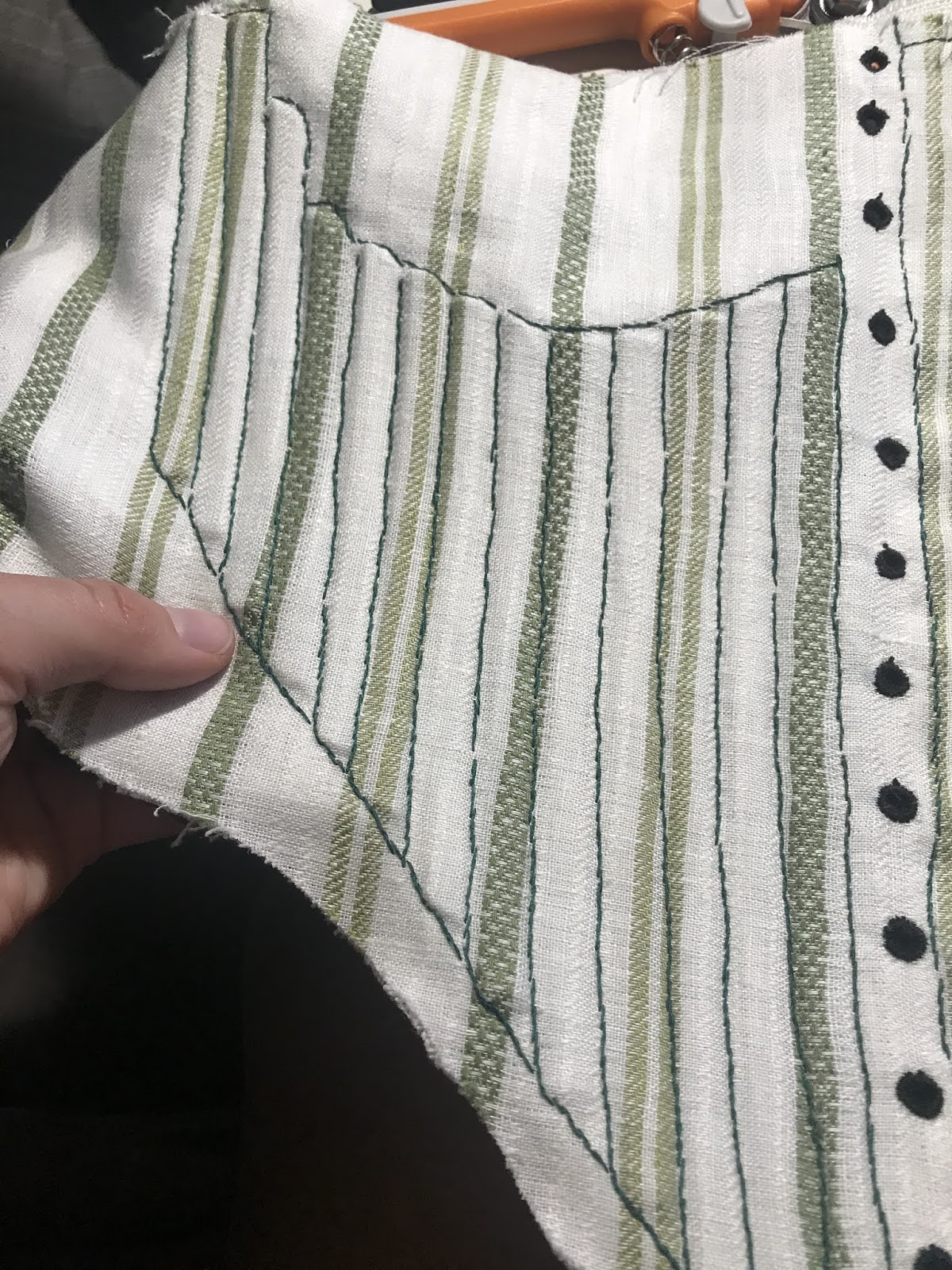
I then went on to the front pieces.  I made the first chanel along the edge that will be the front center of the corset, and then handworked the lacing eyelets for one side.  This is much easier to do before adding the bones, as I discovered when I was making the waist eyelets at the end.  I really should have done that at this stage!  Then I made the rest of the boning channels, which only come to the underbust, creating "cups".  Then I repeated the process on the other front piece.

Making eyelets in four easy steps:

Step 1: poke a hole.  I use an
awl, but I read that some people
use a knitting needle or similar.

Step 2: 4 little whip stitches, one
on each side, to hold the hole
open while you work.
Step 3: whip stitch (or buttonhole if you
prefer) all the way around once,


Step 4: stitch all the way around
again.


Then I basted the pieces together and tried the bodies on.  They mostly fit, but I forgot I had been meaning to shorten the back a little.  The extra length isn't a problem in my gown, but it is with the bodies.  I was also having a weird problem with some gapping at the top of the back.  So I ripped out the basting on the side seams and cut a little material away at the bottom edge of the back piece and the sides where the side seams go, just under the arms.  I basted the whole thing together again, tried it on, and since the major issues were fixed, I then back stitched over the basting to give the side seams as much strength as possible.  I also covered the inside of the seams with the same ribbon I was going to bind the edges with at this stage.
Binding the inside seams.

Next, I added the bones to the front of the bodies.  I used synthetic whalebone because it's closer to the whalebone used in late 16th century examples than plastic boning, and I expect it to hold up better.  I then tried them on before boning the back, and I'm glad I did because I realized that the back of the garment didn't really need all six bones.  I decided to only add two to prevent the back from rolling up at the center.  I suspect the bones at the center back of the original were mostly there to keep the lacing straight, but since I adjusted for front lacing, this isn't an issue.  I'd still sew the channels or something to hold the layers of fabric together- and stiffen the back- next time, though.
Inside front, with bones.


Waist tabs, trimmed to size.
Once the bones were added, it was time to make the waist tabs.  I cut out 5 3.5x3 inch rectangles from the lining, interlining, and canvas.  The original pattern had 8 tabs, but I decided that scaling those down to my size would result in awkwardly small tabs, so I just made fewer of them.  I basted the three layers of fabric for each tab together, then rounded out the corners of the "bottom" of each one, and bound the edges.  I then attached them to the bodice by stitching them on with the right sides together.

Binding the edges of the tabs


Finally, I just had to bind the raw edges.  I did this using black grossgrain ribbon because I didn't feel like making bias tape.  I just whip stitched the ribbon first to the outside and then to the inside, taking care to keep things neat in to corners and curved edges.  The last step was to make 3 sets of eyelets at the waistline for pointing my petticoat to the corset.

All in all, I think it turned out well.  This is a utilitarian piece- it's underwear, after all!- and it does its job well.  It's pretty comfortable to wear, too, and there's enough extra room in the lacing for me to gain or lose a few pounds and still have it fit.  There are a couple of things I'd do differently next time, but they're mostly just things that would make the construction easier, like making all the eyelets before adding the bones.  The only one that's really for aesthetic purposes is that I'd add another full length bone on the other side of the lacing eyelets to prevent wrinkling, but that's not bad enough for me to redo anything.  I don't think there will be a next time unless this one wears out!

Finished inside

Finished outside

Monday, May 25, 2020

Venetian Partlet/ Falling Ruff

My new Venetian partlet/ falling ruff!


The ruff is probably the most quintessential piece of late 16th century fashion, but as far as I can tell, the big round dinner plate ruffs you see in late Elizabethan England were never common in Venice, and in the 1560s and '70s, the "ruff" seems to be more of a ruffle attached to the partlet.  Since most of my wardrobe is mid-century Venetian, I decided to make one of these.

The Venetian "falling ruff" is pretty common in portraits from the second half of the 16th century, as are partlets with no ruffle.  Some of the partlets appear to be linen, and others appear to be sheer silk, though the ruff almost always appears to be linen and/or lace.  This leads to the interesting idea that perhaps some ruffs were detachable, and not an integral part of the partlet, but for the sake of simplicity, I decided to make mine one piece.  I may make another one in the other style at a later date, though, in a fancier fabric.

Francesco Montemezzano, 1565-75
This partlet/ruff appears to be linen, trimmed
in lace.  I think I got pretty close to this look!
For this partlet/ruff, I'm using the same sheer white linen I use for 16th century chemises.  I used it for a ruffle collar on an Elizabethan chemise once, and it worked well for that, so why not, right?  It's not going to be completely plain, though!  Many of the partlets and ruffs in portraits appear to be decorated, often with pearls, lace, or blackwork or metallic embroidery.  I'm not very good at embroidery and mostly see pearls on collarless partlets, so I'm using some lace to make this elegant enough to go with the silk gown I'm planning.


The internet, Tudor Tailor, and common sense tell me a partlet pattern looks something like this:


Two front pieces and one back piece, in this case with a rectangular collar and a ruffle.  The measurements on my diagram are mine.  Shoulder seam to neck, and top of shoulder to underbust for the front, Shoulder seam to shoulder seam for the back, and collar bone to collar bone around the back for the collar.  Venetian partlets in portraits usually appear to have a v-neck effect, so I made my pieces a little narrow at the top and wider at the bottom.  There should also be a small semicircle cut out of the middle of the back top to accommodate the neck.  I'm going to do that when I have the shoulders sewn up, though, because I'd rather eyeball it than do math.  I'm also opting to make ties for the bottom out of ribbon rather than sewing them, because this makes my life a lot easier.  Some people pin their partlets on, or just make them long enough that they stay in place, but I prefer ties at the sides, so that's what I'm doing.


Very long ruffle, stitched together and
hemmed.  See my tiny (less than 1/2
inch) seam?
First, I attached the front pieces to the back with flat felled seams at the shoulders.  This is my favorite method of finishing seams because it hides all the raw edges without the bulk of French seams, but if you prefer French seams, they're also common in period.  Next, I tried on the partlet and cut out the back neckline.

Then I moved on to the ruffle.  I cut out my ruffle in several pieces to conserve fabric, resulting in a total length of about 48 inches, 4 times the length of the collar.  Since it was in pieces, the first step was to sew the pieces together, again with flat felled seams.  I then hemmed one side and both ends, and then attached the lace.

Sewing on the lace!
This is how the ruffle looks pinned to
the neck band.  Time to stitch!
Next, gathering the ruffle into the neck band.  Using very small gathering stitches, I gathered the ruffle to the length of the neck band. Then I pinned and stitched the ruffle to one of the neck band pieces.  This was kind of a pain.  Normally, I would use a whip stitch and be sure to catch either side of each pleat, but I was worried about the raw edges of this delicate linen holding up and wanted a bigger seam allowance, so instead, I stab stitched the two together, still stitching on either side of each tiny pleat.  Kind of annoying, especially since the edges of the lace kept catching the thread, but it worked.
Whip stitching the ruffle to
the neck band.

Then I sewed the neck band to the partlet, leaving seam allowances free at either end.  In retrospect, I should have pinned both neck pieces to the ruffle at the same time, but I didn't think about that until the first one was sewn on already, so the next step was attaching the second neck band piece to the ruffle.  This time, I just pinned the pieces right sides together and whip stitched over the edges, which was a mistake- I missed some of the raw edges of the ruffle, and had to go back and redo sections.  This may not have been a problem if I had been more careful the first time, but then again, I couldn't see all the layers very well.

Finally, I just had to attach the second neck band piece to the partlet.  I did this by folding the raw edges under and using tiny whip stitches, making the stitches as invisible as possible.  I put this seam on the outside of the partlet rather than the inside like I normally would because the ruffle falls over this seam, so it's actually less visible than the inside of the neck band.  This is also the side of the ruffle with visible stitching attaching the lace and holding the pieces together.  The outside of the ruffle is the underside, so this won't show when it's being worn.

Using small stitches to attach
the neck band to the partlet.
Once all the pieces were sewn together, all the "tricky" parts of this project were done!  Now all I had to do was hem the partlet and add the underarm ties and trim on the neckline.  Nothing complicated here, so this all went pretty quickly.

That's it!  All done!  One step closer to a complete mid-16th-century Venetian ensemble!


One step closer to a complete ensemble!


Tuesday, April 28, 2020

Making My Blue Venetian Dress


As I mentioned in my previous post, this dress was meant to be practice- a sort of overdone mock-up- for the green silk Venetian gown I'm planning to make soon.  I make no claims for the historical authenticity of making a dress like this in linen- that's a subject for a future post!  Since the whole point of this project was to make sure my pattern really fit and see if my technique needed any tweaking before making the dress in the expensive fabric, I opted not to spend money on this project and use what I had in my stash, which was a pretty blue heavyweight linen for the fashion fabric and a light linen/cotton blend for the lining.  I did buy a few yards of gold silk ribbon for the lacing, but otherwise, this was all with fabric I already had on hand!

This bodice pattern, on top of the
one I cut it down from.  See the
difference?
The first step of this project was figuring out my pattern.  I have a bodice pattern I made a long time ago by tracing a bodice I'd bought at my local Renaissance fair and then adjusting as needed to get the look and fit I wanted for a kirtle I made, which fits well.  To get the pattern for this bodice, I traced that pattern and then adjusted it a bit.  I took in the sides of the back piece a bit and removed about an inch and a half from the center front, on either side of the lacing.  This moved the seams from the middle of each side to the side back of the dress and allowed for the open front.  I made a quick mock-up of the bodice, found that it seemed to fit the way I wanted, and decided to go ahead and cut out my canvas interlining and my lining fabric.  Note: this step went quickly because I was just adjusting a bodice pattern I've worked with before for several projects.  If your pattern is new, expect to make several mock-ups!

First I basted together the lining and interlining along the bottom and sides.  Then I added boning channels, three on each front panel and three on the back, and inserted the plastic bones.  Next time, I'll probably bone the front a little more heavily, but this works well enough.  I'll probably also have two layers of interlining, one canvas and one linen, next time.  I didn't this time because I was afraid I'd run out of fabric, and this dress isn't meant to be formal anyway, so it really doesn't matter what the inside looks like. 

Adding the lacing ribbons.  Next time, I'll add
another layer of lining so the boning channels
aren't visible.  

Once the bones were inserted, I attached the ribbons the lacing goes through, stitching the ribbon down every inch or so and making sure the openings for the laces are directly across from each other.  This is a technique for ladder lacing that's all over the internet, and it works well, but I'm not sure of its historical authenticity.  I may use lacing rings next time, as I think they would be sturdier and easier to lace up.
It fits!

Next, I tried on the bodice and it fit!  Yay!  Time to cut out the fashion fabric!

I cut the blue linen out with a wide seam allowance, pinned it to the outside of the bodice, made sure there were no wrinkles, and folded the raw edges under while pinning it to the inside, clipping along the curves as needed.  Then I whip stitched the blue fabric down making sure to catch the canvas interlining but not go all the way through and leave visible stitches.  Finally, I pinned the bodice pieces right sides together and back stitched everything together.  Bodice is done!

Stitching the blue fashion
fabric to the lining.  
Time for the skirt!  I cut out two big rectangles of my desired skirt length plus seam allowance from the fashion fabric, selvedge to selvedge because while this results in a second side seam, it was a more conservative use of fabric.  The fabric was 59" wide, so two panels make for a little over 3 yards worth of skirt- plenty of volume!

Then I laid one of my panels over the lining fabric to cut that out the same way, and realized that my lining fabric was only 54" wide.  Oops...  So I made a third, smaller panel for the lining, which worked, but looks a little silly.  Oh well, no one is looking at my dress lining, right?

Gathering the skirt to the
bodice.  
So I sewed my fashion fabric panels together, then did the same on my lining, leaving an 8" gap at the top of the right side on both for my pocket.  Then I sewed the bottom edge of the two pieces right sides together, flipped them the right way out, folding them so that the lining wouldn't show, and pressed.  Finally, I made a 6' slit at the top front, finished that and the pocket opening, and made a little hem at the top.  Skirt finished!

The last step was to gather the skirt to the bodice, which I did by gathering half the skirt at a time and pinning it to the bodice, right sides together, then whip stitching the two together, making sure to catch the canvas interlining as often as possible, and making 2-4 stitches per pleat.

Dress is done!  Now time for sleeves!

I made a pair of sleeves a while ago that turned out to be a little too big, so I tried those on, figured out how much I needed to adjust the pattern by, and made a mock-up.

Like my grocery bag pattern?  I cut down the pattern from
an old pair of sleeves that didn't really fit, so there's a lot
of confusing writing on the other side, but this is the basic
pattern I used for these sleeves, and would also use for sleeves
without panes. 
Still too big!  But mock-up #2 fit, so I cut the panes and stitched them together at the top, and it fit!  So I cut out my blue linen and my lining.  I pinned them together (right sides together if your fabric has a right side!) and drew lines on them 1.5" apart and 4" long for the panes.  Then I sewed around the panes on one sleeve, leaving a small seam allowance.  Then I cut along my lines, flipped them right sides out, and discovered that the seam allowance wasn't wide enough.  The cotton/linen blend I used as a lining frayed a lot!  So I whip stitched over the edges to protect them, then I flipped the fashion fabric and the lining inside out, and stitched those seams, finished the opening, and finally stitched the panes together with a couple of stitches at each corner.  Then I repeated the process on the other sleeve, leaving a bigger seam allowance between the panes this time!
Finished sleeve!  If you look closely,
you can see where the lining started
to fray when I flipped it right side out,
but I don't think people will notice when
I'm wearing it.  

Finally, I just had to attach the ribbon ties to the sleeves and make eyelets in the shoulders of the dress to lace them through.  Done!

And then I tried the dress on to take pictures, and discovered that I had made a mistake on the skirt.  This is a V-shaped bodice, so I should have shaped the top of the front panel to compensate for the bodice length, but I didn't.  The difference in length was noticeable, and the front hem was dragging on the ground a little, so I had to fix it.  I had two choices: either fix the skirt at the top by undoing the pleating, hem, and front opening, or fix it at the bottom by ripping out the seam between the fashion fabric and the lining and hemming all the way around.

I went with the second option.  I ripped out the bottom seam, pinned the hem at the correct length, and trimmed a little off the front.  Then I folded the raw edges in and used an invisible hem stitch all the way around.  All better!


Fixing the hem.  I ripped out the seam, found the correct front length, pinned, and hem stitched. 

The hem lengths match!  Yay!


I know this dress started out as an overdone mock-up, but I really love how it turned out!  It's honestly one of my favorite things I've made yet.  I will definitely be wearing it a lot, if we're allowed to have events for me to wear it to this summer!